

In the demanding arena of rugby league, defensive structure often separates the contenders from the pretenders. While attacking flair captures headlines, it is the disciplined, organised defensive line that underpins success. For top clubs, the ability to work as a cohesive unit in defence is non-negotiable. This pillar guide explores the essential drills that build a formidable defensive line, offering practical insights for coaches, players, and enthusiasts seeking to understand the mechanics of elite rugby league defence.
The Fundamentals of Defensive Line Organisation
Before delving into specific drills, it is crucial to establish the foundational principles that govern defensive line work. In rugby league, the defensive line is not merely a wall of players; it is a coordinated system of pressure, communication, and spatial awareness. The objective is to compress the attacking team’s time and space, force errors, and ultimately regain possession.
Key Principles of Defensive Structure
- Line Speed: The collective movement of the defensive line towards the attacking team. Controlled aggression is paramount—too fast risks gaps; too slow invites penetration.
- Slide Defence: A lateral shift where defenders move across the field in unison, maintaining spacing and covering overlaps.
- Number-Up Defence: A system where defenders mark specific attackers, often used in structured sets close to the try line.
- Communication: Verbal and non-verbal signals between players to adjust positioning, call switches, and alert teammates to threats.
Drill 1: The Slide and Press
The slide defence is the bedrock of modern rugby league. This drill trains the entire defensive line to move laterally while maintaining a compact shape, ready to press forward when the ball is played.
Objective
Develop coordinated lateral movement and controlled line speed across the field.Setup
- Position 10 to 13 defenders across the field at 10-metre intervals, simulating a standard defensive line.
- Place two attacking players with a ball on one sideline, with a support runner.
- Cones mark the defensive line starting point and a secondary line 5 metres behind.
Execution
- The attacking player runs laterally across the field, passing the ball to the support runner.
- The defensive line slides in unison, keeping shoulders square and eyes on the ball.
- When the attacking player commits to a pass or run, the defensive line presses forward, closing the gap.
- Defenders must maintain spacing—approximately one arm’s length between each player—to prevent gaps.
Coaching Points
- Emphasise “feet first, eyes up.” Players should shuffle laterally, not cross their feet.
- The inside defender calls the slide direction (e.g., “Slide left!”).
- The line must not “rush” out of alignment; controlled acceleration is key.
Match-Day Context
This drill mirrors scenarios seen in high-level matches, where a disciplined slide defence forces opponents into touch or into the arms of waiting defenders.Drill 2: The Number-Up Defensive Set
When the attacking team is close to the try line, the defensive line must transition to a “number-up” system, where each defender marks a specific attacker. This drill replicates goal-line defence, a critical phase in any match.
Objective
Train defenders to identify and engage their assigned attacker, preventing line breaks close to the try line.Setup
- Position 6 to 8 defenders on the try line, spaced evenly.
- Place an equal number of attackers 5 metres out, with a dummy half (hooker) positioned behind the ruck.
- A ball feeder simulates quick play-the-balls.
Execution
- The dummy half passes the ball to an attacker.
- Each defender steps forward to engage their assigned opponent, using a “shoulder-to-shoulder” contact technique.
- Defenders must communicate switches if attackers cross paths (e.g., “Switch! Switch!”).
- The drill continues for 4 to 6 tackles, with defenders resetting after each play-the-ball.
Coaching Points
- Defenders should maintain a low body position, with hands up to contest the ball.
- The “inside shoulder” rule applies: defenders protect the inside channel, forcing attackers towards the sideline.
- Quick recovery after the tackle is essential to reset the line.
Match-Day Context
In high-stakes matches, goal-line defence separates champions from contenders. This drill instils the discipline required to withstand repeated attacking waves.Drill 3: The Rush and Contain
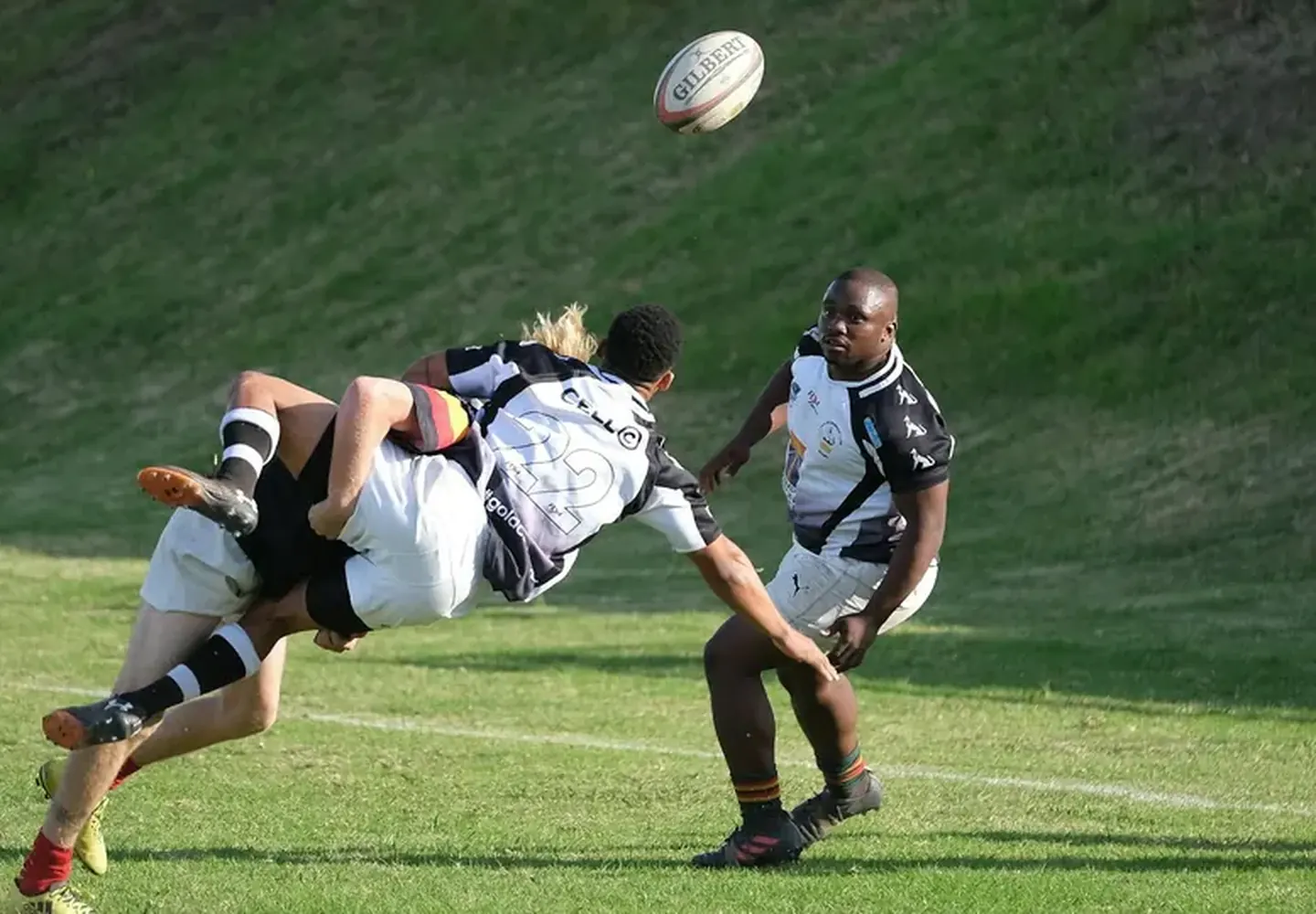
Not every defensive situation calls for a slide. Against fast, expansive attacks, a “rush” defence can disrupt timing and force errors. This drill teaches defenders when to accelerate and when to hold.
Objective
Develop decision-making skills for varying defensive pressures: rushing the ball carrier or containing the attack.Setup
- Position 8 to 10 defenders in a standard line at 10 metres.
- Place three attackers on the field: a halfback, a centre, and a winger.
- A coach or feeder stands behind the attacking line.
Execution
- The feeder calls a direction (e.g., “Rush left!” or “Contain right!”).
- On the left side, defenders accelerate towards the ball carrier, aiming to tackle before the pass.
- On the right side, defenders hold their ground, sliding laterally to maintain shape.
- The ball carrier decides whether to pass or run based on defensive pressure.
Coaching Points
- Rush defence requires explosive acceleration and a “chest-on-chest” tackle technique.
- Contain defence demands patience; defenders must not overcommit to a dummy runner.
- Communication is vital: “Rush!” or “Hold!” calls must be clear and timely.
Match-Day Context
This drill prepares teams for unpredictable attacking structures. A well-executed rush defence can force errors from even the most composed playmakers.Drill 4: The Unstructured Recovery
In the chaos of a broken play, defensive structure often collapses. This drill simulates scenarios where the defensive line must reorganise under pressure, a skill that separates elite defences from average ones.
Objective
Train players to quickly reset their defensive line after a line break or kick return.Setup
- Position 10 defenders in a loose formation (simulating a broken play).
- Place 5 attackers with a ball, spread across the field.
- A coach signals the start of the drill with a whistle.
Execution
- The coach blows the whistle, and the attackers spread out, simulating a counter-attack.
- Defenders must communicate to identify the nearest attacker, form a new line, and “number up” as quickly as possible.
- The drill continues for 20 to 30 seconds, with the attackers attempting to exploit gaps.
- Defenders are penalised if they leave a player unmarked or fail to communicate.
Coaching Points
- The fullback (or last defender) often directs the line, calling numbers (e.g., “We have six, they have four!”).
- Players must scan the field for threats, prioritising the ball carrier.
- Recovery speed is critical; jogging back to position is unacceptable.
Match-Day Context
This drill mirrors the intensity of a match where quick restarts and broken plays are common. A fullback frequently orchestrates defensive recoveries, using vision to organise the line under duress.Drill 5: The Kick and Chase
Defensive work does not end with the tackle. Kick chases are a specialised skill that requires speed, coordination, and anticipation. This drill focuses on the defensive line’s response to attacking kicks.
Objective
Train defenders to pressure the kick receiver and cover the field effectively.Setup
- Position 10 defenders at the 40-metre line.
- A kicker stands at the 30-metre line with a ball.
- Two attackers (fullback and winger) wait at the 20-metre line to receive the kick.
Execution
- The kicker sends a high ball towards the receivers.
- Defenders sprint towards the landing zone, forming a “chase line” that converges on the receiver.
- Defenders must avoid “blocking” each other; they should fan out to cover potential offloads.
- The first defender to arrive makes the tackle; others support to prevent offloads.
Coaching Points
- Chasers must watch the ball in flight, adjusting their path to the landing point.
- Communication is essential: “Mine!” or “Your ball!” prevents collisions.
- Defenders should aim to arrive simultaneously, creating a wall of pressure.
Match-Day Context
Effective kick chases force errors, such as dropped catches or rushed passes, which can lead to try-scoring opportunities.Drill 6: The Two-Person Tackle Circuit
Individual tackling technique is the foundation of defensive line work. This drill focuses on the coordination between two defenders to execute a dominant tackle, a skill critical for stopping powerful ball runners.
Objective
Develop two-person tackling technique, emphasising leg drive and ball control.Setup
- Pair defenders; each pair faces a ball carrier with a tackle bag or pad.
- Cones mark a 5-metre by 5-metre square.
Execution
- The ball carrier runs into the square at moderate pace.
- The first defender targets the ball carrier’s waist, driving forward with legs.
- The second defender targets the ball carrier’s legs, completing the tackle.
- The pair must work together to drive the ball carrier backwards, simulating a dominant tackle.
Coaching Points
- The first defender must “wrap and rip” to dislodge the ball.
- The second defender should aim for the knees, ensuring the ball carrier cannot offload.
- Communication: “I have the waist!” and “I have the legs!” coordinates the effort.
Match-Day Context
Dominant tackles disrupt the attacking team’s momentum. This drill builds the trust and coordination necessary for such efforts.Integrating Drills into Team Training
A structured training regimen is essential for embedding these drills into a team’s defensive identity. Coaches should consider the following framework:
- Warm-Up: Begin with a dynamic warm-up, such as the exercises outlined in our rugby league warm-up routine, to prepare players for high-intensity work.
- Skill Repetition: Dedicate 20 to 30 minutes to fundamental drills (e.g., Slide and Press, Number-Up).
- Game Simulation: Progress to unstructured drills (e.g., Unstructured Recovery) to test decision-making.
- Cool-Down and Review: Analyse video footage of the drills, highlighting successes and areas for improvement.
Periodisation
- Pre-Season: Focus on technique and conditioning, with high drill volume.
- In-Season: Maintain drill work but reduce volume to preserve energy for matches.
- Finals Preparation: Emphasise game-specific scenarios, such as goal-line defence and kick chases.
The Role of Goal Setting in Defensive Development
Defensive improvement is not accidental; it requires deliberate goal setting. Players and teams should establish clear, measurable objectives for their defensive line work. For example:
- Individual Goals: “Maintain a tackle completion rate of 90% in training drills this week.”
- Team Goals: “Concede no tries from inside our 20-metre zone in the next match.”
Conclusion: Building a Defensive Legacy
Defensive line drills are the unsung heroes of rugby league success. They transform individual talent into collective resilience, enabling teams to withstand the fiercest attacks. For coaches and players at any level, the drills outlined in this guide offer a pathway to defensive excellence—one built on discipline, communication, and relentless repetition.
As you integrate these drills into your training regimen, remember that defence is not merely a phase of play; it is a mindset. It demands commitment from every player, from the front-row forwards to the fullback, and it requires a willingness to endure physical and mental challenges. Yet, the rewards are profound: a defensive line that moves as one, that frustrates opponents, and that creates opportunities for counter-attacks.
For further resources on player development, explore our comprehensive guide on player development gear, which covers essential equipment for training and match preparation. Additionally, our rugby league warm-up routine provides a structured approach to preparing your team for defensive drills.
In the end, the most successful teams are those that embrace the grind of defensive training. They understand that every slide, every tackle, and every recovery is a step towards success. Whether you are a coach seeking to elevate your team’s performance or a player striving for personal improvement, the drills in this guide will serve as your foundation. Now, step onto the training paddock, set your line, and build a defence that stands the test of time.
Reader Comments (0)